Project
A large-scale cosmological simulation modeling the reionization of the Universe from the cosmic dark ages to z = 3
The Lumina project is a large-scale cosmological simulation designed to understand one of the most important transformations in cosmic history: the reionization of the Universe. By combining a well-tested galaxy formation model with state-of-the-art radiation transport, Lumina follows how the first generations of stars and black holes flooded the cosmos with light, ionizing the intergalactic medium and shaping the properties of galaxies we observe today.
Motivation and Big Picture
The cosmic dawn marks one of the most dramatic transformations in the history of the Universe. In the first billion years after the Big Bang, the first stars and galaxies condensed out of pristine gas and ignited, flooding the cosmos with ultraviolet and X-ray radiation. This radiation gradually ionized the neutral hydrogen and helium that filled intergalactic space, ending the cosmic dark ages in a process known as cosmic reionization. During this era, light reshaped the Universe on the largest scales.
Cosmic Reionization
Reionization connects the physics of galaxy formation to the evolution of the cosmic web. Its timing, duration, and spatial structure depended sensitively on when galaxies formed, how efficiently they produced ionizing photons, and how those photons propagated through the intergalactic medium. In turn, the radiation field heated diffuse gas and suppressed star formation in low-mass halos, altering the course of subsequent galaxy growth. Reionization was therefore not a simple global phase transition, but a complex and highly inhomogeneous interaction between galaxies and their environment.
Capturing this interplay in simulations is exceptionally challenging. Modeling reionization requires resolving individual galaxies well enough to predict their ionizing output while simultaneously evolving a cosmological volume large enough to represent rare, luminous sources and long-wavelength fluctuations in the radiation field. It also demands a fully self-consistent treatment of radiation transport coupled to galaxy formation physics, and it must follow not only hydrogen reionization but also the later reionization of helium in order to capture the complete thermal history of the intergalactic medium. Until recently, simulations were forced to choose between resolution and scale.
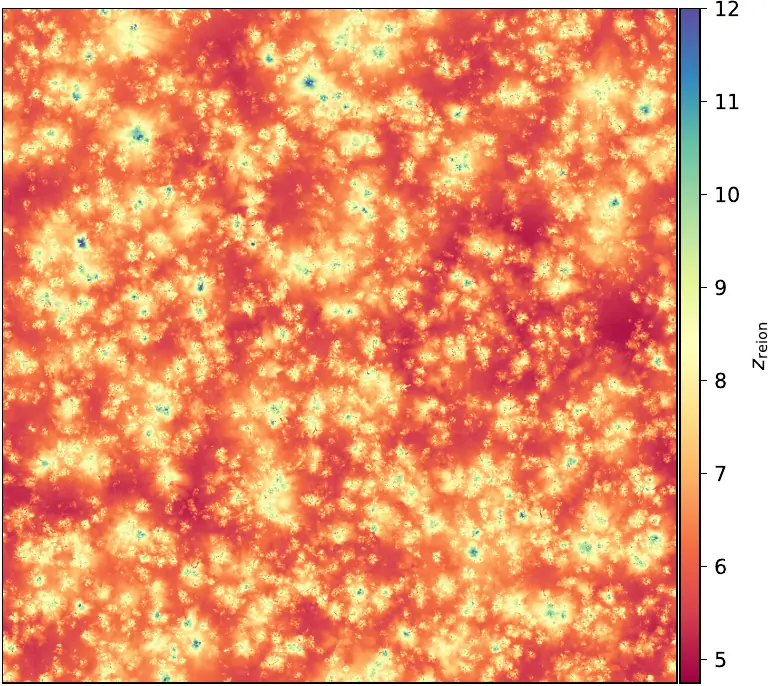
Spatial map of hydrogen reionization redshift across a slice of the Lumina volume.
A New Simulation Milestone
Our new simulation, Lumina, overcomes this long-standing impasse. It evolves a large cosmological volume that is expansive enough to capture cosmic variance and the rare quasars that drive helium reionization, while at the same time maintaining the resolution required to model galaxy formation and radiation transport in detail. Within this single radiation-hydrodynamical simulation, we follow the stellar populations responsible for hydrogen reionization, the growth of accreting black holes that power helium reionization, and the X-ray sources that preheat the intergalactic medium. Galaxies, quasars, and cosmic gas therefore evolve together in a unified and self-consistent framework.
Lumina is the first cosmological radiation-hydrodynamics simulation to model both hydrogen and helium reionization simultaneously and self-consistently in a large cosmological volume. Previous simulations have typically focused on hydrogen reionization alone or treated helium reionization in post-processing or highly idealized setups. By following galaxies, quasars, and the intergalactic medium together across both major ionization epochs, Lumina delivers a unified and physically consistent picture of how cosmic gas was transformed by radiation. This distinctive capability sets Lumina apart from all previous simulations and enables a new class of predictions that directly link ionizing sources to the full thermal and ionization history of the Universe.
Scientific Questions
Many important scientific questions can be addressed with Lumina.
When and how did hydrogen reionization unfold?
One of the central goals of Lumina is to determine the detailed timeline and morphology of hydrogen reionization. While observations indicate that the intergalactic medium was largely ionized by redshift , the duration, patchiness, and large-scale topology of the process remain uncertain. Lumina follows the growth and overlap of ionized regions self-consistently within a cosmological context, allowing us to connect the global reionization history to the underlying distribution of galaxies and large-scale structure.
What sources powered reionization?
A key open question is which astrophysical sources dominated the ionizing photon budget. Star-forming galaxies are widely considered the primary drivers of hydrogen reionization, yet the contributions from faint galaxies, accreting black holes, and high-energy X-ray sources remain debated. Lumina models these populations simultaneously, enabling a quantitative assessment of their relative roles and how their spatial clustering shapes the evolving radiation field.
How did the intergalactic medium heat up?
Reionization did more than ionize hydrogen; it fundamentally altered the thermal state of the intergalactic medium. The timing and inhomogeneity of heating influence the temperature-density relation of cosmic gas and leave observable imprints in the Lyman- forest. By tracking radiation transport and gas dynamics together, Lumina predicts the full thermal history of the intergalactic medium and links it directly to the sources responsible for ionization.
What drove helium reionization?
The second ionization of helium, occurring later at , requires harder radiation typically associated with quasars and active galactic nuclei. Because these sources are rare and highly biased, modeling helium reionization demands a large cosmological volume. Lumina captures the growth of supermassive black holes and their radiation output, allowing us to study how helium reionization proceeded and how it reshaped the thermal structure of the Universe.
How did radiation feedback regulate galaxy formation?
Reionization was not merely a consequence of galaxy formation; it also fed back onto it. The rising ultraviolet background heated intergalactic gas and suppressed star formation in low-mass halos, altering the abundance and properties of faint galaxies. Lumina provides a self-consistent framework to quantify this feedback loop, revealing how the emergence of the first luminous sources transformed their own cosmic environment.
The Lumina Model
Lumina builds on more than two decades of progress in cosmological simulation techniques. At its core lies the IllustrisTNG galaxy formation framework that has been extensively tested for many years and shown to reproduce a wide range of observed galaxy properties from the present day back to cosmic noon. By coupling this proven model to state-of-the-art radiation transport, Lumina bridges a long-standing gap between detailed galaxy formation physics and a fully self-consistent treatment of cosmic reionization.
Hydrodynamics and Galaxy Formation Physics
The simulation follows the formation and evolution of galaxies using the moving-mesh code AREPO, which solves the equations of hydrodynamics on an adaptive Voronoi mesh. This approach combines the accuracy of finite-volume methods with the flexibility of a quasi-Lagrangian scheme, enabling robust modeling of gas flows across a vast range of densities and environments. Star formation occurs in dense gas, producing stellar populations that evolve with time, enrich their surroundings with heavy elements, and drive galactic winds through stellar feedback. At the same time, supermassive black holes grow by accreting gas and regulate galaxy growth through energetic feedback, linking small-scale accretion physics to the large-scale properties of galaxies and their environments. Chemical enrichment is followed self-consistently, allowing the simulation to track the buildup of metals in both stars and gas and to capture their impact on cooling and star formation.
Radiation Transport
What sets Lumina apart is that it transports radiation on the fly through the full cosmological volume. Instead of assuming a spatially uniform ultraviolet background, the simulation tracks how ionizing photons propagate from their sources through the intergalactic medium. Young, massive stars provide the bulk of the hydrogen-ionizing radiation, while additional high-energy photons come from X-ray sources such as high-mass X-ray binaries and shock-heated gas, which can preheat the neutral intergalactic medium ahead of ionization fronts. Active galactic nuclei contribute the hard radiation required to doubly ionize helium at later times.
During hydrogen reionization, the radiation field is discretized into multiple energy bands spanning from the hydrogen ionization threshold up to X-ray energies, allowing the simulation to capture the different mean free paths and heating efficiencies of photons across the spectrum. This multi-frequency treatment is essential for modeling not only when and where gas becomes ionized, but also how it is heated.
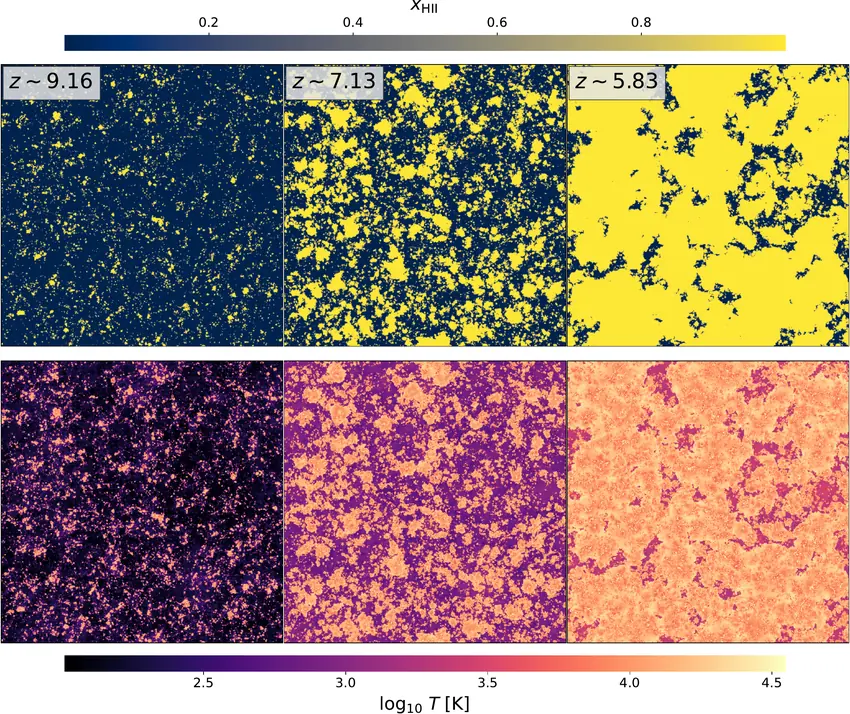
HII fraction and gas temperature during hydrogen reionization.
Non-Equilibrium Chemistry and Thermal Evolution
Lumina does not assume that the gas is in ionization equilibrium. Instead, it explicitly evolves the abundances of hydrogen and helium in their different ionization states, tracking HI, HII, HeI, HeII, and HeIII in time. This is crucial during reionization, when the radiation field changes rapidly and the gas can be far from equilibrium. By coupling radiation transport to non-equilibrium chemistry and gas dynamics, the simulation predicts a physically consistent thermal history of the intergalactic medium. This thermal evolution leaves observable imprints in probes such as the Lyman- forest and provides a direct link between the nature of ionizing sources and the state of cosmic gas.
Algorithmic and Computational Advances
Reaching the combination of physical fidelity and scale required by Lumina demands not only sophisticated physical models, but also major advances in algorithms and performance engineering. The simulation employs a novel GPU-accelerated radiation transport solver that evolves the radiation field alongside the hydrodynamics, dramatically reducing the computational cost of multi-frequency radiative transfer. By offloading the most expensive parts of the radiation solver to modern accelerators, Lumina achieves order-of-magnitude speedups compared to earlier CPU-only implementations, making fully coupled radiation-hydrodynamical simulations feasible in very large cosmological volumes.
In addition, the underlying AREPO codebase has been optimized for extreme-scale computing. Improvements in domain decomposition, communication patterns, and memory usage enable efficient scaling to hundreds of thousands of compute cores and GPUs. Key data structures are shared across processes where possible to reduce memory overhead, and global operations are reorganized to minimize communication bottlenecks. Together, these algorithmic and architectural advances allow Lumina to sustain high performance over the long runtimes required to follow cosmic evolution from the first stars through the end of helium reionization.
Scale and Computing
Lumina pushes cosmological radiation-hydrodynamics simulations to unprecedented scales. Its combination of volume, resolution, and physical completeness enables scientific questions to be addressed that were previously out of reach, especially those involving the large-scale topology of reionization and the rare, luminous sources that shape it.
Scale and Resolution
The simulation volume spans 500 comoving megaparsecs on a side, large enough to contain thousands of massive galaxies and to sample the full range of cosmic environments, from dense protoclusters to underdense voids. This scale is essential because reionization is not a small-scale phenomenon: its spatial variations extend over tens to hundreds of megaparsecs, and only a volume of this size can capture both the patchiness of ionized regions and the impact of rare, highly biased sources such as quasars.
At the same time, Lumina maintains a resolution sufficient to follow galaxy formation in detail. The simulation evolves gas cells and dark matter particles, corresponding to roughly 216 billion resolution elements in each component. The baryonic mass resolution is solar masses, while the dark matter particle mass is solar masses, with a minimum gas spatial resolution of about 440 comoving parsecs. This places Lumina in the same resolution regime as TNG100, the primary calibration target of the IllustrisTNG model, ensuring that the internal properties of galaxies and their global populations are well converged even in this vastly larger volume.
Simulation Parameters
| Parameter | Value |
|---|---|
| Volume | |
| Resolution elements | (gas + dark matter) |
| Total particles | ~432 billion |
| Baryonic mass resolution | |
| Dark matter particle mass | |
| Minimum spatial resolution | ~440 comoving parsecs |
| Redshift range | |
| Cosmology | Planck 2018 |
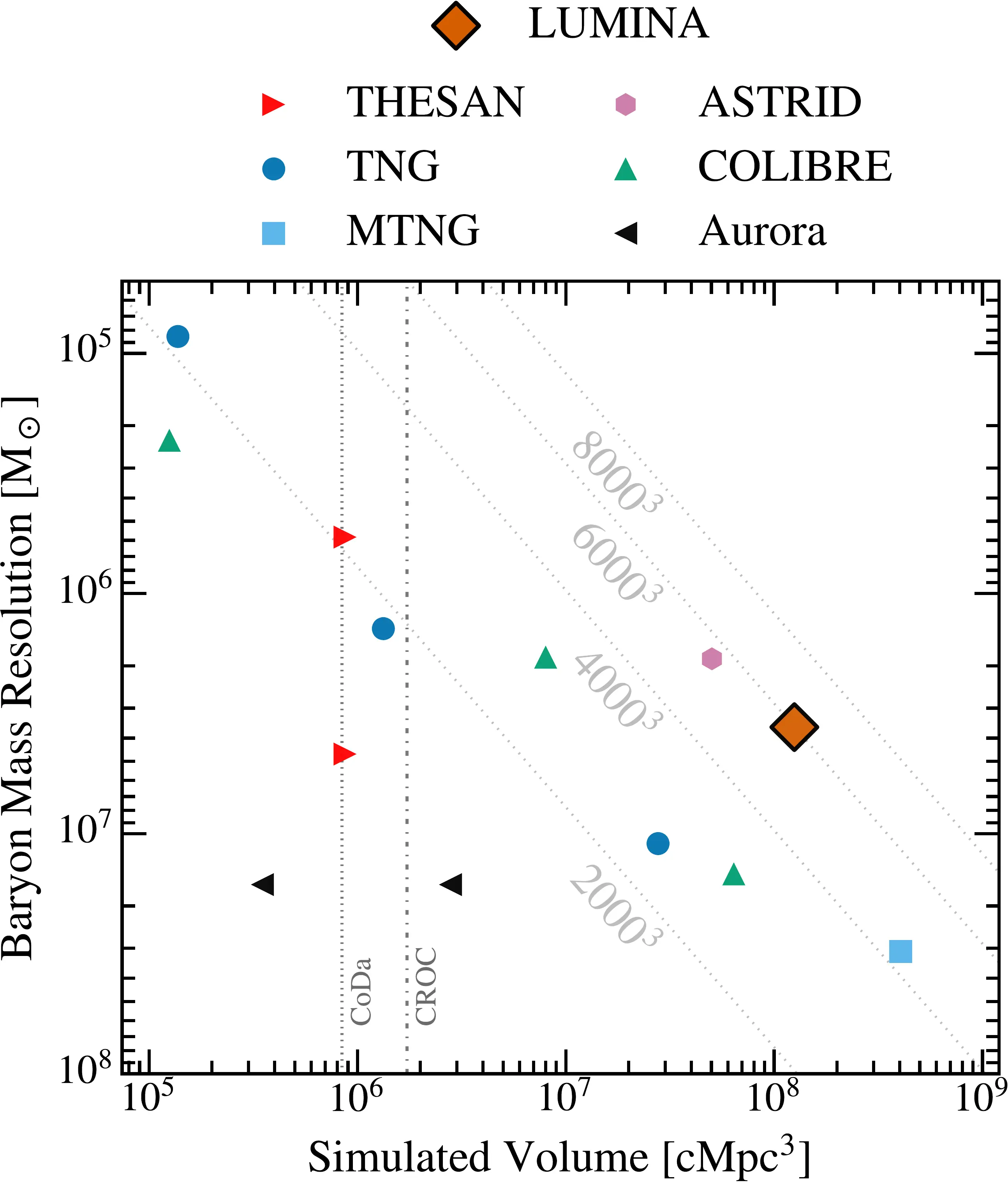
Resolution comparison of Lumina with other cosmological simulations.
Position in the Simulation Landscape
In the broader landscape of cosmological simulations, Lumina occupies a unique region of parameter space. Its volume is roughly 144 times larger than that of the original THESAN simulations, dramatically improving statistical power and enabling robust sampling of rare objects. It is also about 4.5 times larger in volume than TNG300 while achieving roughly three times better mass resolution. Most importantly, it is the first radiation-hydrodynamics simulation to self-consistently model both hydrogen and helium reionization in a volume of this size. By particle count, it is the largest simulation ever performed with the AREPO code, marking a new frontier in coupled galaxy formation and radiation modeling.
Computational Achievement
Reaching this scale required the capabilities of the Frontier supercomputer at Oak Ridge National Laboratory, the first exascale system in the world. Lumina used roughly 20 percent of this massive supercomputer, running on 1,884 compute nodes equipped with 105,504 CPU cores and 7,536 AMD GPUs. Peak memory usage reached approximately 600 terabytes, and individual checkpoint outputs were on the order of 250 terabytes, written at sustained speeds of close to 1 terabyte per second. The GPU-accelerated radiation transport solver was a critical enabling technology, providing the performance needed to evolve multi-frequency radiative transfer alongside hydrodynamics over such an enormous volume and for such long physical timescales.
A New Regime of Simulation
Together, this combination of scale, resolution, and computational power places Lumina in a new regime of cosmological simulation. It enables, for the first time, a fully self-consistent, radiation-hydrodynamical view of galaxy formation and reionization across a truly representative volume of the Universe, connecting the smallest resolved galaxies to the largest ionized structures in a single coherent framework.
Improved Initial Conditions
The initial conditions of a cosmological simulation play a central role in determining its predictive power, especially for studies of the early Universe and reionization. Lumina introduces several important innovations in how these initial conditions are constructed, leading to a more accurate description of early structure formation and, in turn, more reliable predictions for high-redshift observables.
Different Transfer Functions
In most previous large-scale simulations, including Illustris, IllustrisTNG, and EAGLE, baryons and dark matter were initialized with identical density perturbations drawn from the total matter power spectrum. This widely used approximation neglects a fundamental physical asymmetry in the early Universe. Before recombination, baryons were tightly coupled to the cosmic microwave background radiation and were supported by radiation pressure, while dark matter was not. As a result, the two components evolved differently even in linear theory. In reality, dark matter began clustering earlier, since it was never affected by radiation pressure, while baryons underwent acoustic oscillations that left characteristic imprints in their density field.
These effects suppress baryonic power relative to dark matter on all relevant scales, an imprint that persists well into the redshift range probed by reionization studies. Even by redshift , the differences remain at the few-percent level, directly influencing predictions for the Lyman- forest, the 21-cm signal, and the baryon content of early galaxies. Lumina accounts for this by initializing baryons and dark matter with separate linear transfer functions, ensuring that each component starts with the correct, physically motivated clustering properties.
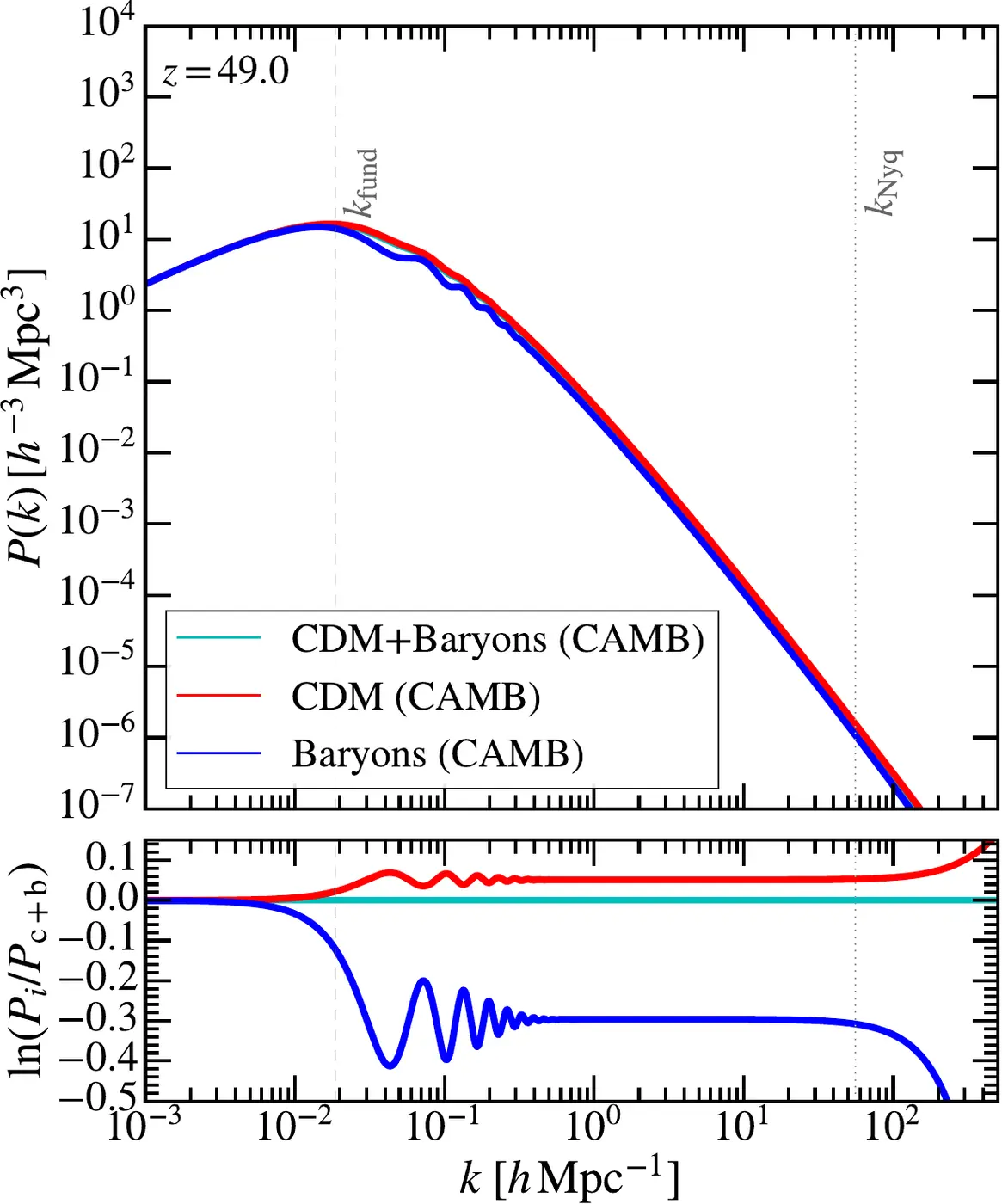
Separate linear power spectra for baryons and dark matter at the start of the simulation.
Streaming Velocities Between Baryons and Dark Matter
The same early-Universe physics also generates a coherent relative velocity between baryons and dark matter, commonly referred to as the “streaming velocity.” At recombination this relative motion was supersonic, with characteristic amplitudes of order 30 km/s. Although the streaming velocity decays as the Universe expands, it has lasting and important consequences for early structure formation. In particular, it delays the collapse of gas into the smallest halos, suppressing or postponing the formation of the first stars. Because the streaming velocity is coherent over very large scales, it also introduces spatial variations in the timing of star formation on scales of order one hundred megaparsecs. These variations can imprint themselves on the 21-cm signal and on the early stages of reionization. Lumina is among the first large-volume simulations to include both separate transfer functions and streaming velocities self-consistently, enabling more accurate and physically complete predictions for the high-redshift Universe.
A Consistent Cosmological Background
In addition to improving the initial density and velocity fields, Lumina also treats the background cosmology with greater fidelity. The simulation includes the contributions of radiation, in the form of cosmic microwave background photons, and massless neutrinos in the expansion history. While these components have only a modest impact at the redshifts directly simulated, including them ensures that the linear growth of structure in Lumina matches the predictions of Boltzmann codes such as CAMB with high precision. This consistency guarantees that the simulation's evolution is anchored to the best available theoretical description of the early Universe from the very first time step.
Impact on Reionization Studies
Together, these improvements in the initial conditions provide a more faithful representation of the early stages of cosmic structure formation. By correctly capturing the different growth histories of baryons and dark matter, as well as their relative streaming motions, Lumina sets the stage for more accurate predictions of when and where the first stars and galaxies form, how reionization proceeds, and how its signatures appear in observables such as the Lyman- forest and the 21-cm signal. This more accurate starting point is a key ingredient in the simulation's ability to connect fundamental cosmology to the astrophysics of the first luminous sources.
Cosmological Model and Initial Conditions
Lumina adopts the Planck 2018 cosmological parameters, updating the values used in earlier IllustrisTNG simulations. The initial conditions were generated at redshift z = 49 using separate transfer functions for baryons and dark matter, allowing the simulation to capture early-Universe effects that are neglected in most previous large-scale runs. This ensures that both the growth of structure and the onset of the first luminous sources are modeled as accurately as possible from the very beginning of cosmic time.
First Results
The first analyses of Lumina already show why combining galaxy formation, radiation transport, and a very large cosmological volume is so powerful. Rather than studying galaxies, quasars, and the intergalactic medium separately, Lumina follows all three together and therefore connects the timing of reionization to the populations of sources that caused it and to the thermal response of cosmic gas. These first results already provide a broad, physically linked view of the high-redshift Universe.
Hydrogen Reionization
Lumina predicts a late, extended, and predominantly stellar-driven hydrogen reionization history. Ionized regions first grow around clustered groups of galaxies, then expand and merge into larger structures until reionization is effectively complete by redshift . Even after that point, small residual neutral absorbers persist for some time, showing that the end of hydrogen reionization is not an abrupt switch but the tail end of a highly patchy process.
These results connect directly to the main observational probes of the epoch of reionization. Lumina predicts the evolution of the neutral hydrogen fraction, the optical depth to the cosmic microwave background, and the large-scale patchiness that future 21-cm measurements aim to detect. At the same time, it provides a physical framework for interpreting constraints from the Lyman- forest and quasar damping wings in terms of the underlying galaxy population.
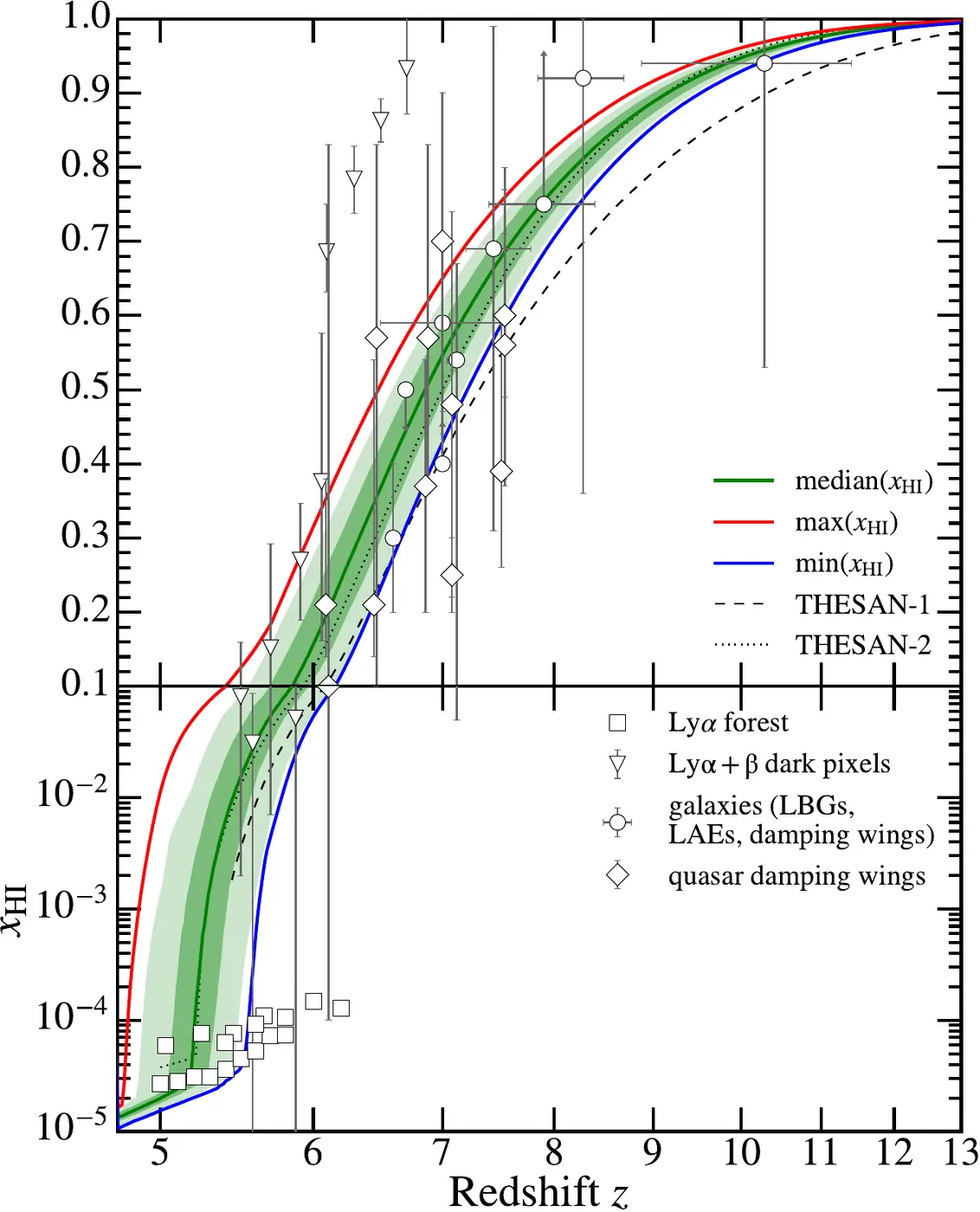
Predicted evolution of the hydrogen neutral fraction during reionization.
Helium Reionization
A major advance of Lumina is that it follows helium reionization self-consistently rather than adding it in post-processing. The simulation shows how rare, luminous quasars produce the hard radiation required to doubly ionize helium, driving a second large-scale phase transition at redshifts around . Because these sources are uncommon and strongly clustered, helium reionization proceeds in a highly inhomogeneous way, with large HeIII regions growing around quasar-rich environments before finally overlapping.
These helium results are especially important because helium reionization does not only change ionization fractions; it also heats the diffuse intergalactic medium for a second time. Lumina therefore predicts a two-stage thermal history: heating during hydrogen reionization, subsequent cooling, and then a renewed temperature rise during helium reionization. This creates a direct link between quasar growth and thermal measurements from the hydrogen Lyman- forest.
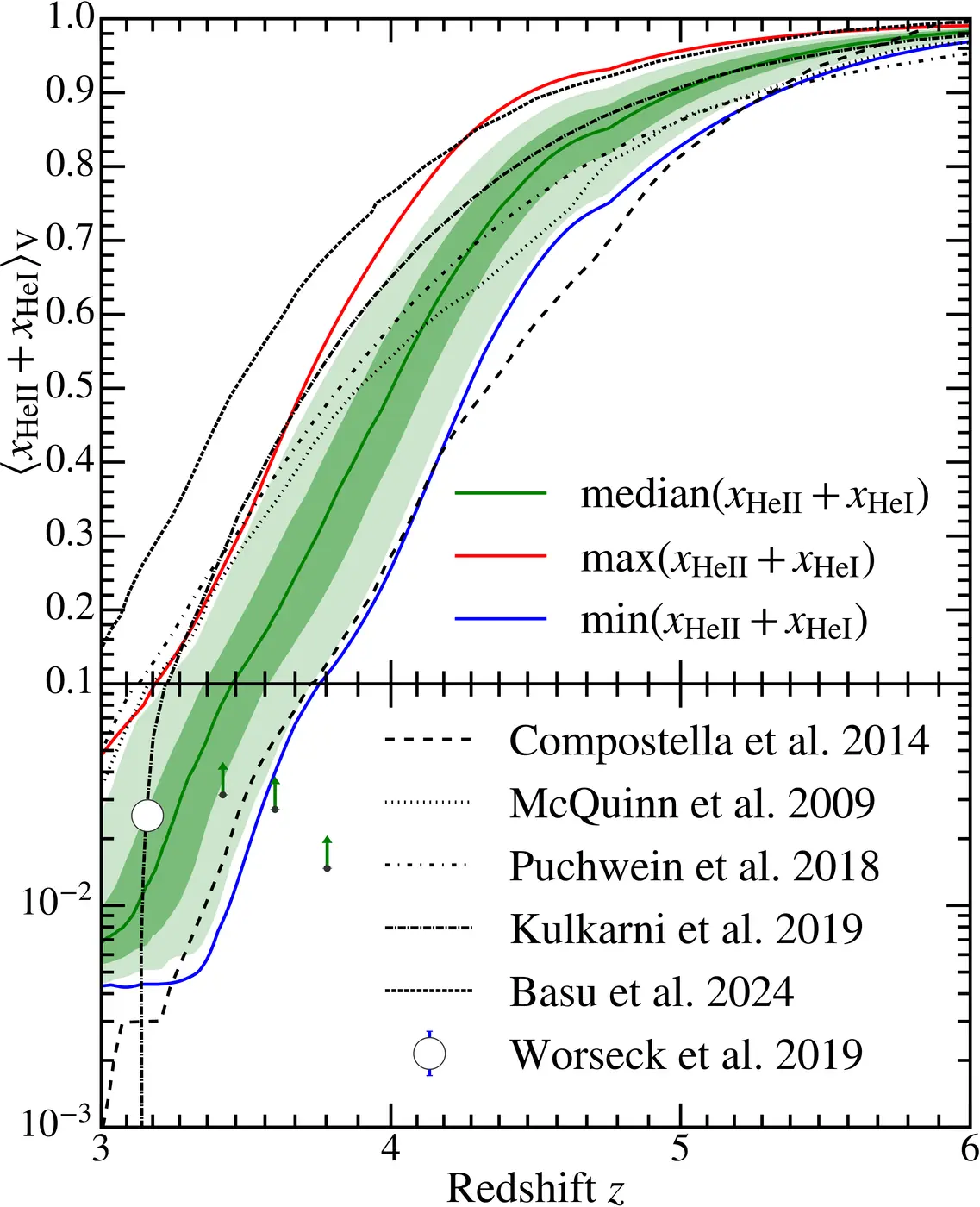
Evolution of the volume fraction of non-doubly ionized helium.
Galaxy Evolution
Lumina also provides a new view of galaxy evolution across the reionization era. An important result is that, despite the added complexity of on-the-fly radiation transport and the much larger volume, the simulated galaxy population remains broadly consistent with the well-tested IllustrisTNG framework and with available observational constraints. This gives confidence that Lumina is not only capturing the ionization history of the intergalactic medium, but also the underlying galaxy population in a realistic way.
The first galaxy measurements already trace the buildup of the cosmic star-formation-rate density and show how that growth is tied to reionization. Lumina can therefore address both sides of the problem at once: galaxies drive the radiation field, while that radiation field heats gas and suppresses star formation in the most vulnerable low-mass systems. The larger volume also provides much better statistics for rare bright galaxies and for environmental trends than was previously possible in fully coupled radiation-hydrodynamical simulations.
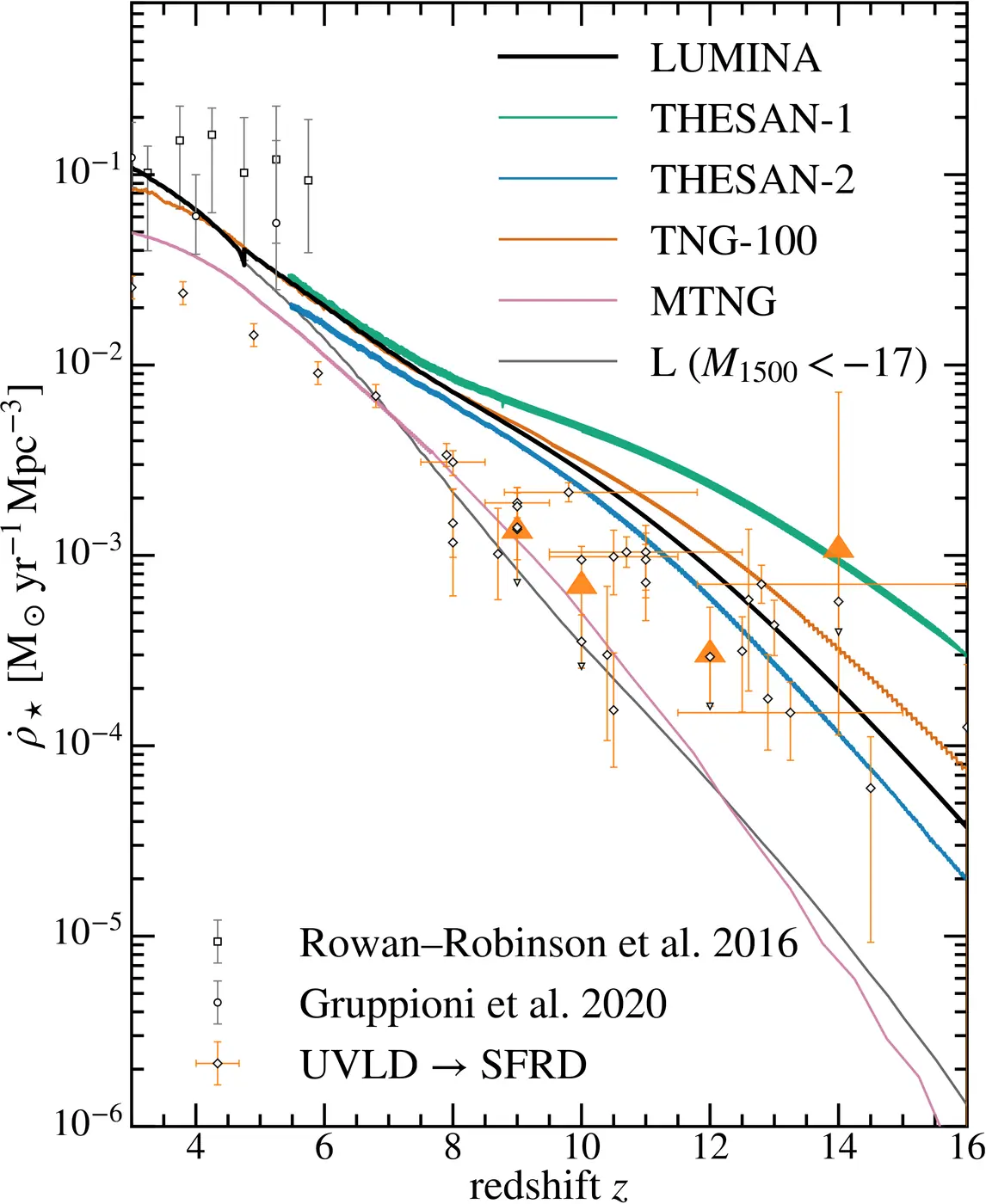
The evolving cosmic star-formation-rate density predicted by Lumina.
Black Holes
Lumina follows the growth of supermassive black holes and their AGN activity within the same simulation that tracks galaxies and the intergalactic medium. This is essential for understanding helium reionization, because the rare, luminous quasars powered by accreting black holes are the dominant producers of the hard photons needed to doubly ionize helium. In Lumina, black-hole growth is therefore not an isolated ingredient; it is directly tied to the thermal and ionization history of the wider Universe.
The first AGN analyses show that Lumina produces a population of active black holes that can be compared directly with observational estimates of quasar and AGN abundances. These results indicate that the simulation captures both the rare, extremely luminous quasars and the broader population of growing black holes that may be more difficult to observe because of obscuration. This opens the door to connecting black-hole growth, AGN luminosity functions, and the helium-ionizing photon budget within a single physical model.
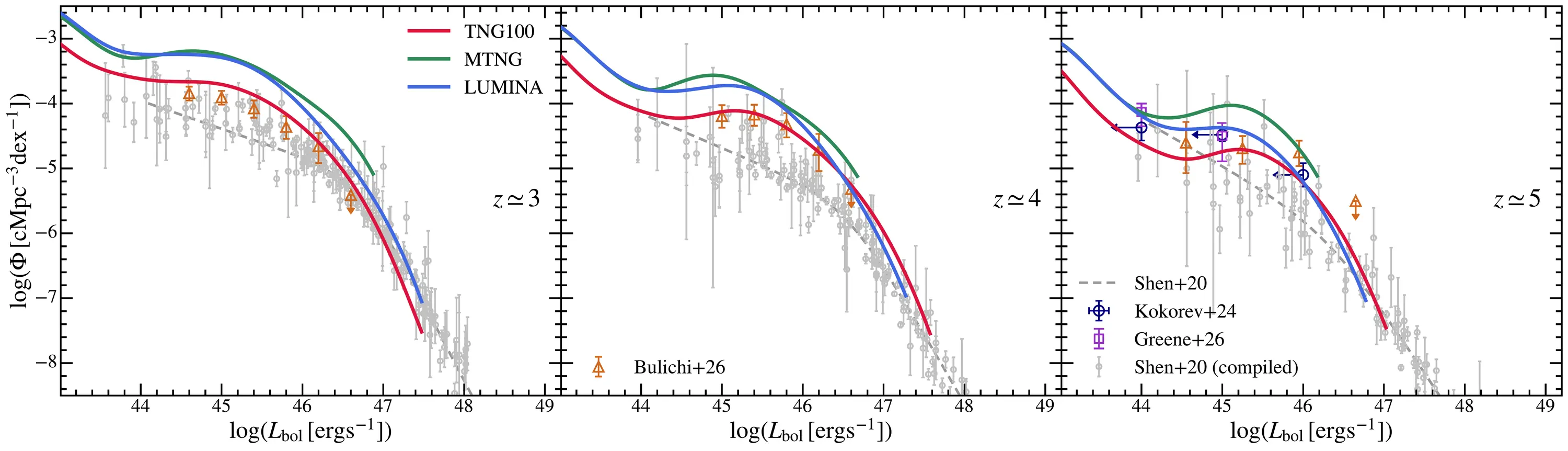
Predicted AGN bolometric luminosity function in Lumina across multiple redshifts, compared with other simulations and current observational constraints.
Table of contents